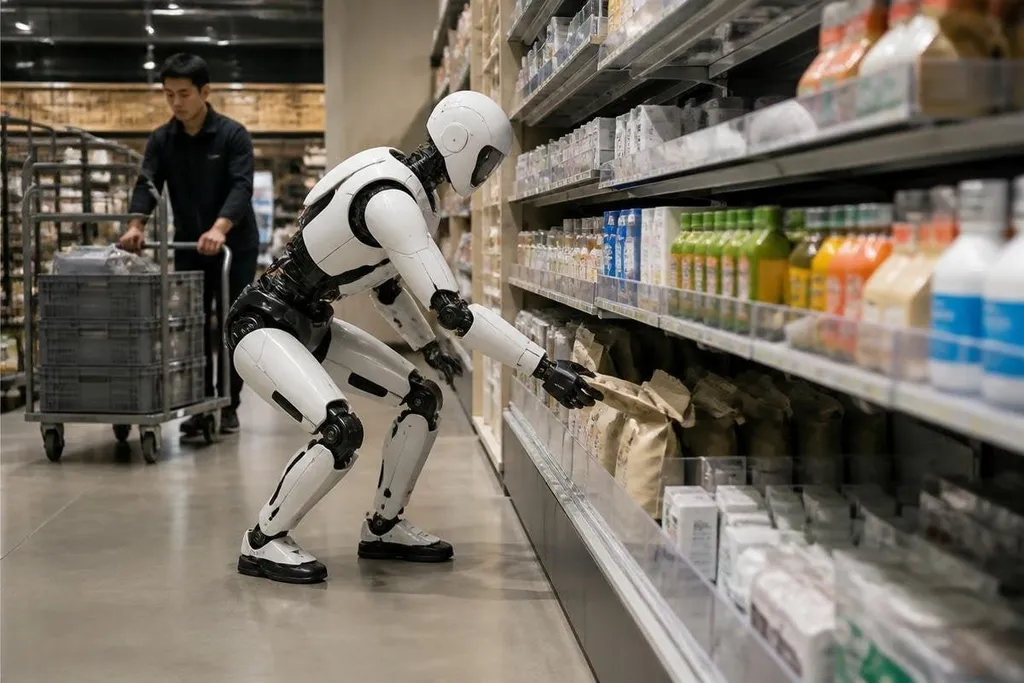
A humanoid robot can use doors, stairs, shelves, and tools built for people. That makes retail an easy place to test the idea, but a store trial still has to show useful work at a sensible cost.
- Retail tasks need repeatable results, not a polished video.
- The trial should count human help, safety stops, charging time, and completed work.
- A robot may fit existing store spaces while still costing too much to run.
What retailers want the robot to do
Retail work contains many tasks that repeat across a shift. A robot could move cartons from a back room, carry items to a shelf, scan products, or collect goods for an online order. These jobs sound simple until the robot meets a blocked aisle, a soft package, or an item in the wrong place.
The useful question is not whether the robot can perform one task. It is how often the task finishes without a person taking control. A trial should record completed jobs, failed attempts, pauses, and the time needed to reset the robot after an error.
That record also shows where the robot fits. A machine that moves empty totes for several hours may help with back-room work. The same machine may struggle with shelf replenishment, where it needs careful hand control and accurate product recognition.
Why use a humanoid shape
Retail stores already contain equipment made for human bodies. Shelves have familiar heights. Doors have handles. Stock rooms use carts, ladders, and boxes that people can move by hand. A humanoid form may let one robot work in these spaces without a full store redesign.
The shape brings limits as well. Two legs add balance problems, while hands need to grip objects with different sizes, surfaces, and weights. A robot that walks safely on a clear floor may need a slower speed near customers or loose packaging.
The trial must show why legs and hands help more than a wheeled robot, a conveyor, or a purpose-built arm. If one of those machines can do the same job with fewer stops and lower service needs, the humanoid has a harder case to make.
What a useful trial measures
Retailers need a test plan before a robot enters a working store. The plan should define the task, the work area, the allowed human help, and the result that counts as success. A short supervised test can show movement; it cannot show the cost of a full shift.
Store-floor figures mean more when a report identifies the robot, task, date, and measured result. Robot24.com's retail robotics reporting can put those details beside the trial, giving you a clear record to compare with your own shift data.
The most useful figures come from the store floor. Count how many tasks finish, how many require teleoperation, how long the robot waits for a person, and how often staff must move objects into a better position. Track charging, maintenance, safety stops, and the time lost when the robot leaves the task area.
A retailer also needs a human comparison. Measure the same task with the staff and equipment already in place. The robot earns a place when it improves a defined result after its own operating cost, training time, service work, and safety controls are included.
Where the trial can fail
Crowded aisles create a harder test than a closed lab. Customers change direction. Boxes appear in walkways. Store lighting shifts, products move, and shelves become partly empty. Each change can affect vision, balance, or the robot's planned route.
Human help can hide these problems. A remote operator may guide the robot around an obstacle or correct a bad grip. That can keep a demo moving, but the retailer must count the operator's time as part of the system.
Safety needs its own record. The store should know how the robot stops, who can stop it, how quickly it stops, and what happens after contact with a person or object. A machine that needs constant watching may add work for staff instead of removing it.
Battery use also shapes the result. A robot that works for a short period, then needs a long charge or a person to change its battery, may suit a small task but fail across a full trading day. The trial should test the complete work cycle.
A decision guide for a store trial
Before approving a humanoid robot test, check these points:
- Name one task: Define the item, route, handoff, and finished result.
- Set a human-help limit: Record every remote control action and physical reset.
- Run the store conditions: Include customers, blocked paths, mixed packaging, and normal lighting.
- Count the full cost: Add staff time, charging, service, training, and safety equipment.
- Compare existing tools: Test the same job with current staff, carts, shelves, or fixed automation.
I'd wait for a trial that publishes these measures before treating a humanoid robot as a retail purchase. The next useful proof is simple: one store, one defined task, and a full cost per completed job.